Rooting

As Galeri 77 opens the doors to its new space, it enters a new chapter in its history. The inaugural exhibition entitled Rooting reflects that transition by tracing the gallery’s journey through recent works by the 38 artists it represents.
By selecting one work from each artist and arranging them according to the chronology of their affiliation with the gallery, the exhibition creates a visual timeline connecting past and present. Yet this timeline is more than a retrospective. It is also a statement of new beginnings and a reflection on the gallery’s continuous evolution. As visitors move through the exhibition, they encounter the history of Galeri 77 while witnessing how this history becomes the ground for future artistic dialogues in its new home.
Upon entering Galeri 77’s new exhibition space, visitors are first greeted by the faces of those who give the gallery its soul: the artists. Displayed along the entrance, their portraits introduce the creative minds that have shaped the gallery’s identity and immediately establish the exhibition as, above all, a celebration of its artists.
From there, the exhibition unfolds chronologically, beginning on the top floor and continuing all the way down to the ground floor. Each artwork marks the moment when its creator first became part of Galeri 77. The exhibition therefore traces not only the development of the gallery itself, but also the individual histories of the relationships between the gallery and its artists. Past, present, and future emerge as parts of a living and continuously evolving narrative.
Throughout the exhibition, the works are connected by a root-like structure that links them to one another as well as to the architecture of the building. The wooden lines are therefore more than an aesthetic or formal element of the exhibition design. Conceptually, they underline the relationships between the artists and the gallery, while simultaneously forming a line of thought and a line of sight that guides visitors through the exhibition.
The line does not behave like a neutral graphic device. It grows, turns, rises, drops, branches, passes behind and around artworks, and at times almost becomes a frame. Rather than functioning as a diagram, it develops into something resembling a living system—simultaneously architectural and organic.
In Rooting, the idea of taking root is understood not as something static, but as a dynamic and even entropic process. Roots seek their own paths. They encounter obstacles, change direction, branch out and sometimes penetrate seemingly impenetrable structures in order to continue growing. In this sense, a root is simultaneously an archive and a condition for growth: it preserves what has developed while making future development possible.
Rooting therefore looks as much toward the future as it does toward the past. It considers how ideas, positions and artistic visions circulate, evolve and move beyond what is already known, opening up new ways of encountering the world.
The exhibition ends in the basement, where an installation composed of video images of the artists and fragmented echoes of their voices creates an immersive audiovisual environment. Individual voices overlap, words and ideas circulate through the space, and a productive cacophony emerges. Like a family gathering in which the excitement of being together generates its own energy, this final space returns us to what lies at the root of the exhibition and forms the foundation of the gallery itself: the artists, their works, their visions, and their courage to share challenging, personal and sometimes intimate ideas with us.
Rooting is therefore more than a group exhibition. It is a statement about the relationship between a gallery and its artists, and about the understanding that gallery management extends far beyond the administration and presentation of artistic production. Beneath the visible surface of the art world lies a complex habitat of relationships, histories, affinities and exchanges. Many of the coordinates within this multilayered matrix remain invisible, developing through rhizome-like connections and references.
The exhibition invites its visitors to follow these lines, to look beneath the surface, and perhaps to dig a little deeper—revealing new perspectives on both the production and the mediation of contemporary art.
-
 Gurgen Babayan, Vaftiz / Baptism, 2022
-
Daron Mouradian, Sefahat / Debauche, 2025
-
Armen Gevorkian, Oyun / Game, 2004
-
Armen Gevorkian, Bir Terzinin Günlüğünden Anılar N4 / Memories from a Tailor's Diary N4, 2023


-
Roman Babakhanian, Taş Hikâyeleri N39 / Stones Story N39, 2025
-
Vahram Davtian, Büyük Şehir Buradan Başlıyor / The Big City Begins from Here, 2024
-
Gago, Sirk Geldi / The Circus has Arrived, 2025
-
Sarkis Hamalbashian, Çevirmen Toplantısı / Translator Meeting, 2022


-
Bahadır Baruter, Şişkolar III / Fatties III [Ed.3 + 1 AP], 2026
-
Karen Arakel, Angela, 2019
-
Karen Arakel, Daniel, 2024
-
Karen Arakel, Nelly, 2017


-
Sergey Narazyan, Çingene / Gypsy, 2025
-
Sergey Narazyan, Papatyalar / Daisies, 2025
-
Sergey Narazyan, Üçgen / Triangle, 2025
-
Sergey Narazyan, Kırmızı ve Siyah / Red and Black, 2025


-
Mehmet Resul Kaçar, Ve avlanan tavşanın kulağı deliktir / And the Ears of the Hunted Rabbit Were Pierced, 2024
-
Mesut Karakış, İsimsiz / Untitled, 2022
-
Vav Hakobyan, Boom, 2021
-
Narek Arzumanyan, Eski Sebepler / Old Motives, 2018
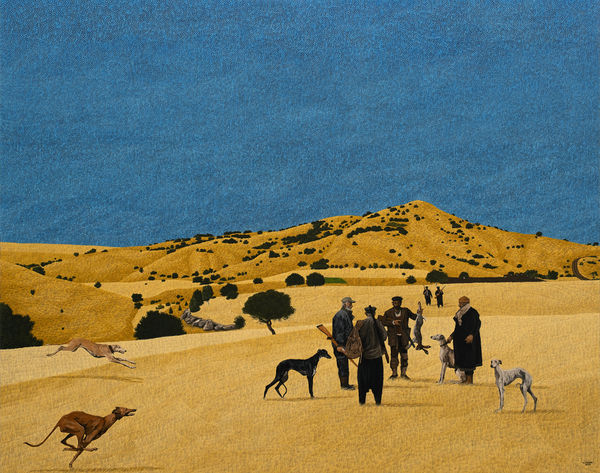


-
Arman Vahanyan, İsimsiz / Untitled, 2016
-
Ani Qananyan, İsimsiz / Untitled, 2020
-
Tigran Sahakyan, İsimsiz / Untitled, 2012
-
Armén Rotch, İsimsiz / Untitled, 2017


-
Mikayel Ohanjanyan, Bağ #6 / Legami #6, 2019
-
Mahir Kurtulan, Girdap / Vortex, 2026
-
Gayane Avetissian, Siyah Fil / The Black Elephant, 2021
-
Sedat Girgin, Bu Ben Değilim n:4 / This is Not Me n:4, 2024


-
Sedat Girgin, Aynalar Salonu N8 / The Hall of Mirrors N8, 2022
-
Sedat Girgin, Walk of Absurd N6-1, 2024
-
Edgar Grigoryan, Nesne Özne 1 / Object Subject 1, 2014
-
Evgenia Saré, Aile Portresi / Portrait de Famille (Family Portrait), 2019


-
Sam Grigorian, İsimsiz / Untitled, 2017
-
Sam Grigorian, İsimsiz / Untitled, 2019
-
Artur Eranosian, Yönetici / Intendant, 2024
-
Taron Marukyan, İsimsiz / Untitled, 2023


-
Nevres Akın, İsimsiz / Untitled, 2020
-
Roman Kakoyan, Ayçiçeği Muhafızı / Guardian of Sunflowers, 2023
-
Narek BARSEGHYAN, İsimsiz / Untitled, 2025
-
Erhan Coral, Kahve, Hiçbir Yerde / Coffee, Nowhere [Ed.3 + 1 AP], 2025


Related artists
-

Nevres Akın
-

Mutlu Aksu
-

Karen Arakel
-

Narek Arzumanyan
-

Gayane Avetissian
-

Roman Babakhanian
-

Gurgen Babayan
-

Narek Barseghyan
-

Bahadır Baruter
-

Yıldırım Çakmakçı
-

Erhan Coral
-

Vahram Davtian
-

Bayram Demir
-

Artur Eranosian
-

GAGO
-

Armen Gevorkian
-

Sedat Girgin
-

Sam Grigorian
-

Edgar Grigoryan
-

Hakan Gürbüzer
-

Vav Hakobyan
-

Sarkis Hamalbashian
-

Mehmet Resul Kaçar
-

Roman Kakoyan
-

Mesut Karakış
-

Mahir Kurtulan
-

David Martirosyan
-

Taron Marukyan
-

Daron Mouradian
-

Sergey Narazyan
-

Mikayel Ohanjanyan
-

Ani Qananyan
-

Armén Rotch
-

Tigran Sahakyan
-

Evgenia Saré
-

Tigran Tsitoghdzyan
-

Arman Vahanyan