Tabula Rasa: Gayane Avetissian
Past exhibition
Overview

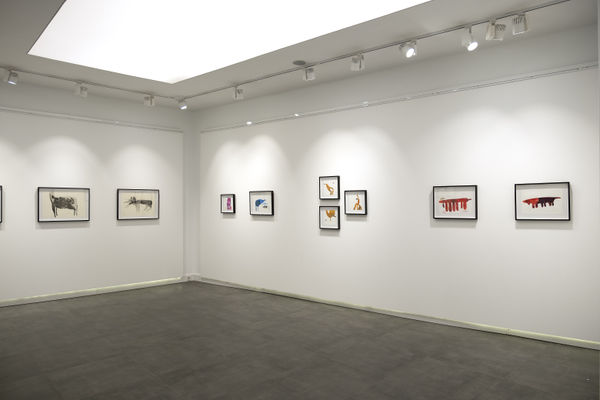
In Tabula Rasa, Gayane Avetissian approaches the idea of the “blank slate” not as a state of absence, but as a charged and paradoxical condition one in which inherited memory, personal experience, and cultural imprint are already present, even before consciousness begins to articulate itself. The exhibition unfolds as an inquiry into how identity is formed, taught, internalized, and ultimately reconfigured through lived experience.
Avetissian’s practice is concept-driven and adaptive, allowing form, line, and color to emerge in direct dialogue with content. Rather than adhering to a fixed stylistic position, she employs a fluid visual language that moves between abstraction, primitivism, realism, and neo-expressionism. This plurality mirrors the layered nature of human perception itself where rational structure and emotional intuition coexist, overlap, and occasionally conflict. In Tabula Rasa, this oscillation becomes a deliberate strategy, reinforcing the instability of the notion of purity or origin.
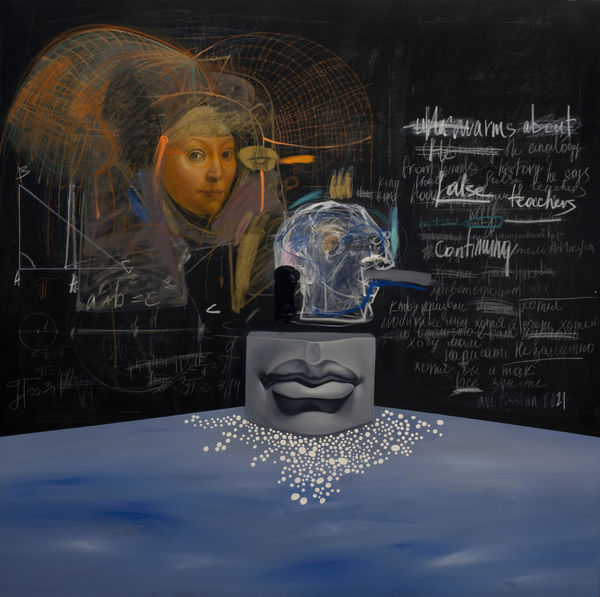
Education, learning, and upbringing function as recurring conceptual anchors throughout the exhibition. Drawing from her Blackboard series and expanding it further, Avetissian questions the philosophical premise of tabula rasa by suggesting that neither the human mind nor artistic expression begins from neutrality. Just as a child arrives into the world carrying genetic, emotional, and cultural inheritances, the artist asserts that even the earliest artistic gestures bear traces of personality, memory, and intuition. Learning, in this sense, is not the act of filling an empty surface, but of negotiating what is already inscribed often unconsciously.
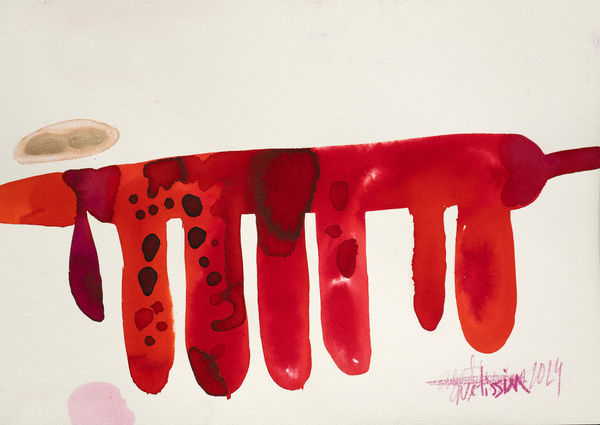
This negotiation extends to Avetissian’s engagement with fear, memory, and self-knowledge. Motifs such as the recurring dog figure, an alter ego rooted in childhood function as symbolic companions throughout the works. Referencing both personal memory and Armenian cultural symbolism, the dog embodies loyalty, protection, vulnerability, and social reflection. Its presence bridges the private and the collective, positioning childhood not as nostalgia, but as an active site of perception and survival. Similarly, bird imagery, central to her earlier Rara Avis exhibition, reappears as a complex symbol of freedom, fear, and confrontation. By transforming ornithophobia into a visual language, Avetissian frames fear not as an obstacle, but as material for growth.
Mythology and cultural memory subtly inform the exhibition without dominating it. Rather than direct quotation, ancient symbols are filtered through a contemporary and introspective lens, allowing them to resonate beyond specific geographies. Avetissian’s approach avoids oppositional binaries between the individual and the collective; instead, personal experience becomes a prism through which shared human conditions are reflected.
Ultimately, Tabula Rasa positions transformation as an ongoing and inevitable process. Learning, confronting fear, and embracing contradiction are presented not as linear progressions, but as cyclical acts of becoming. Avetissian’s works do not propose resolution; instead, they invite the viewer into a space of inquiry where identity is continuously written, erased, and rewritten, and where the blank slate reveals itself as anything but empty.
Works
-
 Gayane Avetissian, Kara Tahta N1 / Blackboard N1, 2021
 -
Gayane Avetissian, Kara Tahta Serisi - Kuş / Blackboard Series - The Bird, 2022
-
Gayane Avetissian, Kara Tahta N2 / Blackboard N2, 2021
-
Gayane Avetissian, “Kara Tahta” serisi N3 / “Blackboard” series N3, 2020



-
Gayane Avetissian, “Kara Tahta” serisi N2 / “Blackboard” series N2, 2020
-
Gayane Avetissian, “Kara Tahta” serisi N4 / “Blackboard” series N4, 2020
-
Gayane Avetissian, “Kara Tahta” serisi N1 / “Blackboard” series N1, 2020
-
Gayane Avetissian, “Moskova'daki Rüyalar” serisi N1 / “Dreams in Moscow” series N1, 2023


-
Gayane Avetissian, “Moskova'daki Rüyalar” serisi N2 / “Dreams in Moscow” series N2, 2023
-
Gayane Avetissian, “Moskova'daki Rüyalar” serisi N3 / “Dreams in Moscow” series N3, 2023
-
Gayane Avetissian, “Gül Şehrinde” serisi N7 / “In the Rose City” series N7, 2024
-
Gayane Avetissian, “Gül Şehrinde” serisi N6 / “In the Rose City” series N6, 2024


-
Gayane Avetissian, “Gül Şehrinde” serisi N9 / “In the Rose City” series N9, 2024
-
Gayane Avetissian, “Gül Şehrinde” serisi N10 / “In the Rose City” series N10, 2024
-
Gayane Avetissian, “Gül Şehrinde” serisi N11 / “In the Rose City” series N11, 2024
-
Gayane Avetissian, “Gül Şehrinde” serisi N3 / “In the Rose City” series N3, 2024


-
Gayane Avetissian, “Gül Şehrinde” serisi N4 / “In the Rose City” series N4, 2024
-
Gayane Avetissian, “Gül Şehrinde” serisi N5 / “In the Rose City” series N5, 2024
-
Gayane Avetissian, “Gül Şehrinde” serisi N1 / “In the Rose City” series N1, 2024
-
Gayane Avetissian, “Gül Şehrinde” serisi N2 / “In the Rose City” series N2, 2024


Installation Views